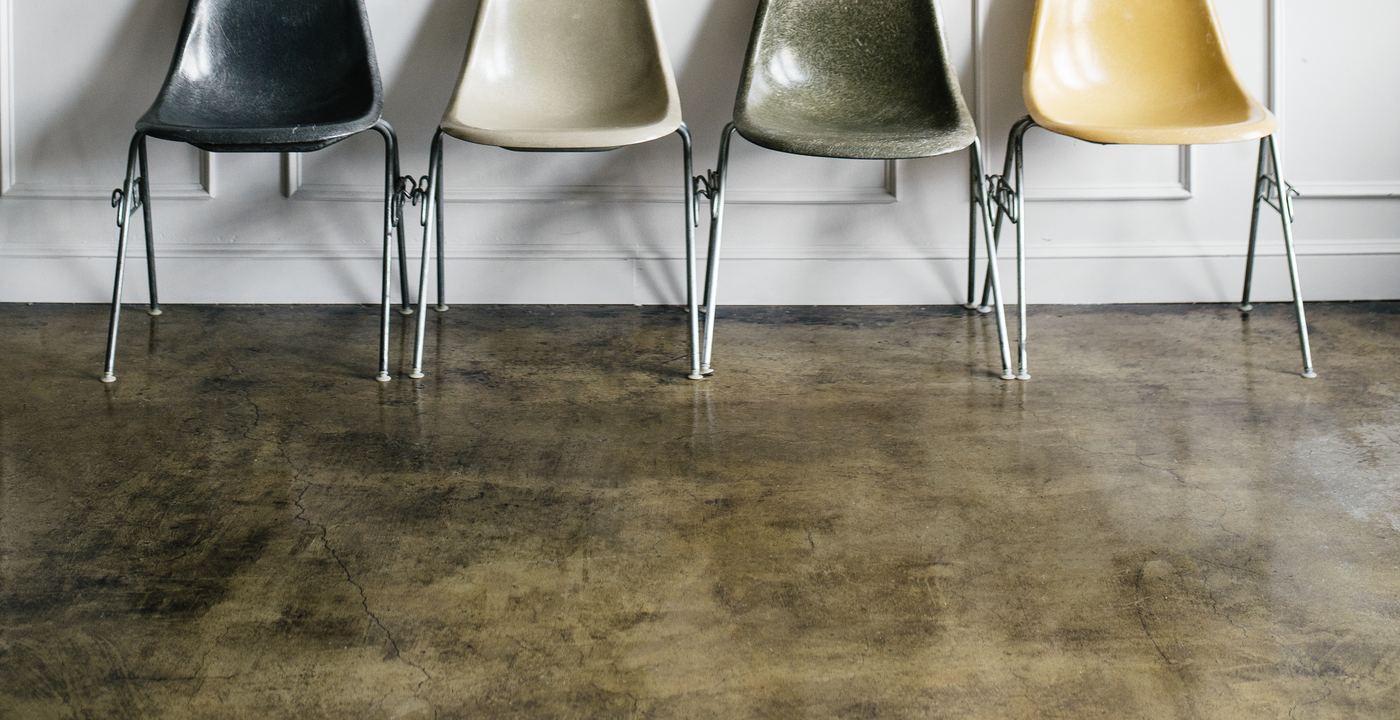
Concrete stain is not paint. Paint is an opaque film that hides the slab. Stain and dye are translucent: they soak into the pores or react with the cement, and the slab's own texture, trowel marks, hairline cracks and tonal shifts show through. That is the whole appeal, and it is also the whole risk. You are not picking a color from a chip. You are pairing a product with one particular piece of concrete.
Three product families do the work. Acid stains are a chemical reaction that produces marbled, stone-like earth tones. Water-based stains are pigment-and-polymer products with a wider palette and more predictable coverage. Dyes are true solutions with very fine colorant that suit interiors and polished floors. Many floors combine them, and most finish with a protective sealer or a mechanical polish. Which mix suits a basement in Del Ray, a restaurant dining room in Old Town, a covered patio in Arlington or a showroom in Fairfax depends on the slab, the use and how much variation you can live with.
This page explains the chemistry in plain terms, why two slabs never stain alike, what stain cannot hide, how a careful job is prepped and sealed, and how interior and exterior floors differ in the DMV's humid summers and freeze-thaw winters. We also say when staining is the wrong call. Stain that is sampled on your slab, applied to clean ground concrete and sealed with the right product lasts. Skip any of those and it becomes an expensive disappointment.
People use the word stain for all three, which causes most of the confusion. They behave differently on the slab and fail in different ways.
Acid stain (reactive)
A mild acid, typically hydrochloric, carrying metallic salts in water. The acid lightly etches the dense surface so the salts can get in, then the salts react with free lime (calcium hydroxide) left over from cement hydration and form colored, insoluble compounds in the pores. Because lime is unevenly distributed, the color comes out marbled, and it is part of the surface rather than a film. Palette: earthy rust, chocolate, amber, gold and copper-patina tones. Afterward the spent acid and residue must be neutralized and washed away completely.
Water-based stain
Pigment and polymer carried in water or acetone. Nothing reacts, so the slab's chemistry matters much less and results are more uniform and predictable. The palette is wider, coats can be diluted to go lighter, and it can work on old or problem concrete. The tradeoff is usually less depth than an acid stain, so installers sometimes layer a second color to build it back. It leans harder on the sealer above it.
Dye (true solution)
Dyes dissolve in water, acetone or alcohol rather than being suspended, and the colorant is much finer than stain pigment, so it can soak into tight concrete. The look is more uniform and saturated, and dye suits stenciling, mottled effects and polished floors. Dyes are generally not UV stable, so they are an interior product, and most makers recommend a clear topcoat to lock the color in.
How an acid stain gets its color
Acid and metallic salts go onA water-based acid solution carries the metallic salts
Reaction with free limeThe salts react with calcium hydroxide in the cement paste
Color forms in the slabTones depend on the mix, age and finish of the concrete
Neutralize and rinseResidue is neutralized and removed before any sealer
SealA sealer locks the look and sets the sheen
Why no two slabs stain alike: the color comes from a reaction, not a pigment sitting on top.
Why every slab stains differently, and why sampling is not optional
Two slabs poured the same week can take identical stain and look nothing alike. Alkalinity and lime content drive acid stain: higher alkalinity generally develops color better, and the lime in a slab declines as it ages. Manufacturers advise waiting about 28 days on new pours so free lime has developed. Temperature changes the result, since the same stain on the same slab can look different at different slab temperatures. Low humidity can dry the water out of an acid stain before it fully reacts, and applying too much leaves product sitting on the surface instead of penetrating.
Finishing matters just as much. Overtroweling or hard burnishing makes the top dense and slow to absorb, while porous areas drink product and go darker. Curing compounds, hardeners, old sealers and contaminants block color in patches. Even something as small as a pipe-thread cutting fluid can stop a slab from reacting.
In the DMV the usual slabs add their own variables. Mid-century basement and garage slabs in Alexandria, Arlington, Falls Church and DC have had decades to collect oil, paint drips, wax, carpet glue and efflorescence. Later townhouse and condo slabs often carry curing agents or treatments we have to identify before anything goes down.
That is why we sample. After diamond grinding, we apply the candidate product to a small, inconspicuous area, let it develop and seal it so you see the true final color. Sample boards only approximate the result, and stain looks flat until it is sealed. You approve the sample on your slab, not a photo. It also shows us early if a patch refuses color, before the whole floor is committed.
Many homes built before the 1970s have no polyethylene sheet under the basement slab, so ground moisture can keep wicking up. That includes plenty of mid-century basements in Alexandria and Arlington and rowhouse basements in DC. Retrofitting an under-slab barrier is not possible on an existing floor, so existing slabs are handled with on-slab measures or a breathable system. Efflorescence, a white salt residue, is the visible sign that moisture is moving through.
For staining this means test first, choose the sealer second. A tight film over a moist slab can cloud or let go, while a breathable penetrating sealer may be the better fit. Garages bring winter brine and oil. Brine and de-icers are carried in on tires, and sealed stained garage floors need a harder topcoat, not just a basic sealer. If a moist basement or oil-soaked slab makes stain a poor bet, we tell you, and we may suggest a different system.
Color charts show a test board, not your slab.
Wet stain, dry stain and sealed stain all look different.
Acid stain can be built up with more passes but not made lighter once reacted.
Judge the sealed sample in the light the room actually gets.
Stain reacts with the slab itself, so no two floors look the same.
What stain cannot hide
Acid stain accentuates surface variation instead of covering it. Every crack, repair, trowel mark, saw cut and old spill can show, and some look worse once color goes on. A stained floor is meant to look like weathered stone with character. If you want one uniform, flawless color, look at metallic epoxy or flake systems, which cover the slab instead of showing it.
The most common source of unhappy stain jobs is expecting the product to cover things it cannot. A translucent color sits over whatever is already there, so the slab has to be honest.
Contaminants show through because bare, clean concrete is needed for the reaction: spills, chalk and pencil marks, burn marks and silicone spray all leave their mark. Old paint, mastic, adhesive and sealer must be removed entirely. Leftovers appear as pale ghost patches in the shape of the old tile or carpet. Patch material and crack repairs rarely absorb color like the surrounding concrete and usually read as lighter or darker areas or lines. We tell you plainly which ones we expect to show, and sometimes work them into a scored design.
A slab that is too damaged is a candidate for a thin overlay or a different system instead. Moisture is another honest limit. If vapor keeps moving through the slab, efflorescence returns, and copper and ferrous-based acid stains can turn black when moisture is present.
Spills, burns, chalk, marker and silicone: show through
Old paint, glue, tile mastic and sealer: must be ground off or they ghost
Patches and crack repairs: usually visible, sometimes turned into a feature
Overtroweled or burnished areas: stain lighter and uneven
Persistent moisture: keeps bringing efflorescence back
Badly spalled or scaled slabs: may need an overlay instead
What stain shows and what it cannot hide
Stain works with
Natural variation, mottling and movement in the slab
Sound, uncoated, well-prepared concrete
A sample patch tested on your actual slab first
Interior floors and properly sealed exteriors
Stain cannot hide
Patches, repairs and fillers that stain a different shade
Old coatings, adhesive or sealer left on the surface
Oil, rust and chemical marks already in the pores
Trowel burns and footprints that read through the color
From the section above; stain reveals a slab, it does not cover it.
How a proper staining job is prepped and applied
Color is the shortest part of the work. This is the general order a careful installer follows. Exact steps and drying times depend on the product, the slab and the weather.
Inspect and test
Look for coatings, sealers, patches, cracks, oil and construction residue, and check whether any admixture or surface treatment will block color. On below-grade and older slabs, test moisture before a sealer is chosen, because trapped vapor can cloud or lift a film.
Remove everything on the surface
Diamond grinding removes coatings, mastic, curing compounds and laitance and opens the pores evenly. We grind every slab and never acid etch. Weak cement paste has to come off, otherwise it can take color and later wash off or let a sealer peel.
Repair cracks, joints and damage
Cracks and spalls are repaired in the written scope. We talk through whether to blend each repair, leave it as a feature or score a pattern, because it will be visible.
Clean, mask and protect
Remove dust and slurry fully, and mask walls, cabinets and thresholds. Stain splatter is permanent, and acid corrodes metal, so surrounding metals and fixtures are protected.
Sample on the slab
Test the approved product, dilution and passes in a small area, sealed, so you judge the finished color.
Apply color in controlled passes
Acid stain goes on in thin coats with plastic or acid-resistant equipment, because less is more and extra product just sits on top. Water-based stain and dye are sprayed or applied in coats. Color is built in passes, and a reaction can need hours before cleanup. Borders, scoring or stencils are added as designed.
Neutralize and remove residue
Rinse thoroughly to neutralize remaining acid and remove unreacted salts and byproducts. This residue, which may contain heavy metals, is collected and disposed of rather than sent down a drain, and rules on wastewater vary. Leftover residue is a common cause of sealer failure.
Dry completely, then seal or polish
Concrete must be fully dry before sealing, because sealing too soon traps moisture. Sealer goes on in thin even coats, or a dyed floor is polished instead. The color is not final until it is sealed.
Sealer options and sheen
The color itself will not wear off, but the sealer is what faces scuffs, water, salt and cleaners, and it largely sets the sheen. Always confirm the exact product with its data sheet.
Acrylic sealers
A common, easy-to-recoat choice that deepens color. Softer than the harder options, so it scuffs sooner and needs recoating on a schedule that depends on traffic. A reasonable fit for light residential use.
Urethane sealers
A harder film with better abrasion and chemical resistance, widely used for restaurants and retail. Needs a clean, dry slab and careful application so it does not bubble or show roller marks.
Epoxy, polyurea and polyaspartic topcoats
Used where wear is severe or chemical resistance matters, such as garages and shops, and sometimes layered over color. Check each product's UV rating before using it outdoors. Our grind and seal page covers clear-coat systems in more detail.
Penetrating sealers
They soak in without a surface film. They suit exteriors where a film could trap vapor, and they are generally preferred over surface coatings for salt and freeze-thaw protection. They enhance color less than a film does.
What a topcoat cannot do
A surface coating does not protect against vapor or groundwater rising from below. On slabs with moisture drive, a film can trap vapor and cause efflorescence and discoloration, which is why testing comes first.
Sheen choices
Matte gives a stone-like look and hides wear. Satin is the all-round choice. Gloss deepens color most but shows scratches and can be slippery when wet. A fine anti-slip additive in the last coat adds traction for entries, patios and commercial floors.
Interiors versus patios and exteriors in the DMV
The same product does not behave the same indoors and out. Outdoor concrete here faces intense summer sun, rain and humidity, and repeated winter freeze-thaw with de-icing chemicals.
Factor
Interior floor
Patio, walkway, pool deck
UV
Minimal. Dyes and stains are fine
Constant. Dyes can fade; acid stain is UV stable; water-based stain depends on pigment quality
Freeze-thaw
Not a factor
Water in pores expands when it freezes and can scale the surface; salt makes it worse
De-icers
Brine tracked in on shoes and tires
Direct contact. Rock salt is harshest; calcium and magnesium products and acetates are gentler
Sealer
Acrylic or urethane by traffic
UV-stable, usually penetrating or breathable; surface coatings alone are not enough for salt
Slip when wet
Low to moderate; matte or satin preferred
Higher; anti-slip additive recommended
Care
Clean regularly, recoat sealer by traffic
Inspect each spring, reseal when water stops beading, rinse salt off
Application caution
Mask and protect fixtures
Acid overspray can kill plants, and runoff with metallic salts must not reach storm drains
Newer concrete is more vulnerable to salt damage, and air-entrained concrete resists freeze-thaw and de-icers better. Outdoor stain is a maintenance commitment.
Polished and dyed floors
Dye and polishing pair naturally. After the slab is ground, dye is applied to the open surface and the floor is then honed through finer diamond grits to the sheen you want. The color is part of the concrete, with no film to wear through, so it handles foot traffic, carts and daily cleaning in restaurants, boutiques and offices.
The tradeoffs are real. The slab must be sound enough to polish, and color depth depends on how much surface is ground away. Some slabs are better candidates than others, so we assess before suggesting it. Where polishing is not realistic, dye with a clear sealer is the usual alternative. Our polished concrete page covers the polishing process and sheen levels. Do not use ordinary dye outdoors.
Color palette guidance
Choose color with the slab, the lighting and the room in mind. These are general guides, not promises about any specific floor.
Earth tones
Rust, chocolate, amber, gold and tan are what acid stain does best. They sit well with wood trim, brick and warm light.
Copper patina and green
Reactive stains can produce weathered copper and verdigris looks, usually variable, not a flat solid teal.
Cool grays and neutrals
These typically come from water-based stain or dye. They suit modern rooms and commercial spaces and show uneven finishing more.
Black and deep dark
Possible with dye or heavy layering, but dark floors show dust, scratches and sealer wear most. Sample and plan for care.
Vivid colors
Reds, oranges and bright blues are dye territory. They suit a ground, polished interior and not exterior sun.
Layering and design
Two or three tones, scored borders or stencils add interest. Combining acid stain and water-based stain can correct color or add dimension, but a design must be planned around joints and repairs.
Three color families, three palettes
Acid stainEarth tones set by the reaction: tans, browns, terracotta and blue-greens. Translucent, mottled, never two alike.
Concrete dyeFine color carried into the surface: a wider palette including blues, reds, greens and black. Translucent; UV limits indoors.
Water-based stainPigmented, more uniform and predictable coverage across a broad palette; semi-opaque options.
Screen colors are approximate. Final color is confirmed with a sample on your slab.
Maintenance that keeps the color looking right
Stained concrete lives well if the sealer is cared for. Sweep or dust mop regularly, since grit scratches sealers. Clean with a neutral-pH cleaner and a soft mop, and avoid strong acids, ammonia and harsh degreasers that dull the film.
Use mats at entries and felt pads under furniture. In DMV winters, road salt and brine tracked in on boots and tires are hard on any sealed floor, and sand and gravel scratch it. Wipe spills promptly, especially acidic ones such as wine and citrus.
When traffic lanes dull, recoat the sealer before it wears through. The color underneath is permanent, so a fresh coat restores the look without redoing the stain. Floors with worn-through sealer need more than a recoat and sometimes a re-clean and re-prep.
Neutral cleaner and soft mop; no acidic or ammonia products
Mats at doors and felt pads on furniture; avoid rubber-backed mats that trap moisture
On patios, rinse off salt in spring and avoid rock salt as a de-icer
Recoat when traffic lanes dull, not after the sealer is gone
Stained concrete versus paint, epoxy and polished concrete
Each system answers a different question. This is how they compare on the points people ask about most.
Stain or dye, sealed
Floor paint
Epoxy or flake
Polished concrete
How it looks
Translucent, slab shows through
Opaque, flat
Opaque or decorative, hides slab
Natural concrete, sheen, dye optional
Color range
Moderate (acid) to very wide (dye)
Very wide
Wide, with flake or metallic effects
Natural or dyed
Hides defects
No
Partly
Mostly
No
Peeling
Color cannot peel; sealer can wear
Common, especially with moisture
Possible if bond fails
No film to peel
Wear resistance
Depends on sealer
Low
High
High
Moisture sensitivity
A film can cloud or lift on a moist slab
High
High; moisture testing is critical
Moderate
Upkeep
Recoat sealer
Repaint
Occasional clear recoat
Burnish or re-polish
Good for
Warm interiors, patios, design floors
Short-term cosmetic fix
Garages, workshops, industrial
Retail, offices, modern homes
Systems combine: a dyed floor can be polished, and a stained floor can take a harder clear topcoat for a garage or shop.
What affects the cost of a stained floor
We give written quotes after seeing the slab, at no charge, because the factors below vary too much to estimate from a phone call. We do not publish prices on this page.
Total square footage, layout and how much cutting in around walls and fixtures is needed
Slab condition: coatings, adhesive or paint to remove, oil contamination, patching and crack repair
Product family (acid stain, water-based stain or dye) and how many colors or passes
Sealer type, number of coats and any anti-slip additive
Polishing steps if the floor is dyed and polished
Interior or exterior, access, and whether the space stays in use
Moisture testing and any measures the slab needs
Questions
Staining and dye questions, answered
What colors can you acid stain concrete?
Acid stain gives earth tones: rust, chocolate, amber, gold and copper-patina greens. Results are variegated, and you can adjust lightness by dilution and number of passes, but it cannot make bright reds or true black alone. For those colors use water-based stain or dye, which can also be layered over acid stain.
What are the disadvantages of staining concrete?
Stain shows flaws, including patches, cracks and contaminants. Results vary slab to slab and cannot be matched exactly to a chart. Acid stain has a limited palette and cannot be lightened once reacted. Residue must be cleaned and disposed of properly, the sealer needs recoating, and outdoor floors take more maintenance. Sealed floors can be slippery without an additive.
Is water-based stain as good as acid stain?
They are different, not better or worse. Acid stain gives a marbled, stone-like look from a true reaction with the slab and is UV stable. Water-based stain gives a wider palette and more predictable, uniform color but usually less depth, and relies more on its sealer. Choose by look, slab and use.
Can you stain old concrete?
Usually, once coatings, adhesive, paint and contaminants are ground off and any weak paste is removed. Older DMV slabs are often workable, but oil, many patches and moisture can limit what is possible. That is why we assess and sample first. Badly damaged slabs may need a thin overlay or a different system.
Will stained concrete fade?
Acid stain is UV stable, and its color is part of the surface. Some dyes fade quickly in sun and are interior only. Water-based stain depends on pigment quality. Sealers also age outdoors, so patios need periodic resealing.
Can I stain concrete that has already been sealed or painted?
Not until the sealer or paint is removed, because stain cannot soak into a film. We grind old coatings off and then test. Remnants cause pale ghost patches, so thorough removal matters.
Can you stain a basement floor?
Often yes, but moisture comes first. Many homes built before the 1970s have no under-slab barrier, so vapor can keep rising. We test before choosing a sealer, and where vapor drive is high a breathable sealer or a different system may fit better.
Is stained concrete slippery?
A sealed floor can be slick when wet, especially in gloss. Matte or satin sheens and a fine anti-slip additive in the last coat improve traction, and we recommend one for patios, entries and commercial floors.
How long does stained concrete last?
The color is permanent, since it is in or under the surface rather than a film that peels. The sealer is the wear layer and is recoated as traffic and exposure require, sooner on patios and busy commercial floors than in a quiet living room.
How long should new concrete cure before staining?
Manufacturers of acid stain advise about 28 days on new pours so free lime can develop. Lime content declines as concrete ages, which can change color depth, so older slabs are sampled rather than assumed.
Can I acid stain concrete myself?
It is possible, and kits are widely sold, but results are hard to control. Prep, even application, neutralizing, residue disposal and sealing all take experience, and the acid needs a respirator, gloves and eye protection. If you try it, sample in a hidden corner first.
Can stained concrete be polished, and how do I get an estimate?
Yes. Dye is applied to a ground surface and then polished, which locks color into the concrete without a film. See polished concrete, or contact us for a free estimate and a sample on your slab.