
Matte or honed
Stops at a lower grit step. Little reflection and more forgiving of footprints. A sensible choice for entries, workshops and spaces that stay damp.
Service
Polished concrete is the slab itself, ground flat, hardened and refined to a sheen you choose.
Overview
Polishing is sanding on an industrial scale. A heavy grinder carries diamond-impregnated tooling across the slab in a fixed sequence, starting with coarse metal-bond segments that cut the surface and level it, then moving through finer and finer resin-bond pads. Along the way the floor is treated with a densifier, a liquid that soaks into the pores and hardens the surface from within. Nothing is rolled on top. If you scratch the floor, you are scratching concrete, not a film sitting on concrete.
That is the line between polishing and the coatings elsewhere on this site. An epoxy, flake system or sealer is a layer, and a layer can lift if moisture or poor prep gets under it. A polished floor has no layer to lose. The tradeoff is honesty: polishing cannot hide a patchy pour, an oil-soaked corner or a poorly finished slab the way a thick coating can. What you see afterward is the concrete you already own, only denser, flatter and more reflective.
Most people picture a mirror in a showroom, and that is one end of a wide range. A satin polish in a finished basement, a salt-and-pepper surface in a shop and a stone-exposed floor in a lobby are all polished concrete, yet they look and perform differently. The real decisions are how deep we cut, how fine we go and what the slab will tolerate. This page covers each one, plus the cases where we would send you toward grind and seal or a resinous floor instead.
Three variables define a polished floor: how deep the grinding goes, how many grit steps follow and what the densifier does. Depth sets the look. Grit sets the sheen. Densifier sets surface hardness.
The Concrete Polishing Council publishes an aggregate exposure chart that describes depth in classes. Class A is cement paste, often called cream, where almost no stone shows. Class B is fine aggregate, the salt-and-pepper look. At the far end is full or large aggregate exposure, where the stone is the surface. The council has revised its chart over time, and older documents list four classes (A through D) instead of three, so a spec should name the chart it is using. Older CPAA material put salt-and-pepper at roughly a sixteenth of an inch of cut and medium aggregate at about an eighth, which shows why deeper exposure removes more slab.
For sheen, one 2025 industry presentation lays out a typical sequence: grinding at about 100 to 120 grit, then about 200 to 220, then a 400 resin step to hone the surface, followed by 800, 1500 and 3000 resin steps to polish, with an optional micro-film pass if needed. Stopping around 400 to 800 gives a soft, honed look. Going to 1500 and 3000 gives a reflective one. Different contractors and tooling brands vary the exact sequence, so ask for yours in writing.
Densifiers are silicate solutions, commonly lithium, sodium or potassium. They react with free calcium hydroxide in the concrete to form calcium silicate hydrate in the pores, which reduces porosity, raises hardness and abrasion resistance and helps the surface take a polish. They do not cure a slab, they do not stop it cracking, and a resin-based curing compound or old coating has to be ground off first or the liquid cannot get in.
Soft, even surface; almost no stone shows
Fine aggregate visible
More stone showing
Stone is the surface; needs strong, well-placed concrete
Approximate depths from older Concrete Polishing Association material; the exposure chart in use should be named in the spec. Deeper cuts remove more slab.
One 2025 industry presentation. Brands and contractors vary the exact sequence, so ask for yours in writing.
The schedule depends on the slab, but a well-run polish follows this order.
Hardness, flatness, cracks, joints, patches, old adhesive, paint, curing compound and oil are all read before any machine starts. Moisture testing belongs here too. This step decides whether polishing is the right system at all.
Cracks, spalls and open joints are filled with a repair material and ground flush. Repairs stay visible as fine lines under a polish, which is why the scope should say what will remain visible.
Metal-bond diamonds remove the surface skin, level high spots and strip glue and coatings. This pass sets the exposure level. A vacuum attached to the grinder captures dust, because concrete dust is a respiratory irritant and a mess in an occupied building.
After the early cuts, densifier is applied and given time to react. Excess is removed so it does not dry into a white residue.
Fine metal and first resin steps erase the scratch pattern from the cut before them. Each step must fully remove the one before it. Skipping a step is the usual reason a floor looks streaky or hazy.
Dye can be added during the refinement stage for color. It follows the slab, so mottling and patches remain visible.
Higher resin grits bring up the sheen. A stain-protecting guard is typically burnished in at the end. It improves spill resistance but is not a film coating.
The floor is cleaned and checked under raking light, and the owner receives care instructions and cleaner guidance.
Exposure and sheen are separate choices. Combining them gives very different floors from the same slab.
Stops at a lower grit step. Little reflection and more forgiving of footprints. A sensible choice for entries, workshops and spaces that stay damp.
A soft glow that looks refined without showing every mark. A common fit for basements and living areas.
Clearly reflective and good for retail and offices. Grit tracked in shows more against a smoother surface.
The finest steps give a mirror-like surface. Striking in showrooms, and the one to approach carefully where floors get wet.
Dye tints the floor in earth tones, gray or black. See staining and dye systems for options and limits.
Cream, salt-and-pepper or full exposure sets the personality more than sheen does. Choose it before the first cut, because it is hard to reverse.
Polishing is subtractive. It removes the surface and shows what is underneath. Thin or soft slabs, patches, shrinkage cracks, honeycombing, trowel marks and old spills all show through. Some owners like that character. Others expect a uniform surface and are disappointed, so judge a sample area before the whole room is cut.
Slip resistance deserves a straight answer. ANSI A326.3 measures wet dynamic coefficient of friction (DCOF), and hard surfaces meant to be walked on when wet with water are expected to reach 0.42 or higher, with a higher 0.50 category added in the 2021 revision for areas such as open restaurant kitchens. The standard itself says the test compares surfaces and does not predict whether a person will slip. Published results on polished concrete are mixed: an ASCC study reported wet DCOF around 0.50 to 0.57, while a slip-testing firm that sells pendulum testers and anti-slip coatings measured 0.41 to 0.75 and argued pendulum testing is more informative. The practical read is that sheen, wear, cleaner residue and contaminants all matter, so ask for test data on the actual finish and choose a lower sheen or a slip-resistant treatment where water is expected.
Stain resistance is realistic, not absolute. Densifier and guard slow absorption but concrete stays porous. Oil, wine, coffee and acidic or citrus cleaners can mark it if left. A stain that sets may mean re-grinding that area.
Cracks and joints stay. Concrete shrinks and moves, and control joints exist so it cracks where intended. Repairs make cracks clean and stable, but they remain visible, and new hairlines can appear. Joints that shift may need fills refreshed over time.
Cold underfoot is a customer complaint worth taking seriously. Owners of DC-area basements describe polished floors that stay cool and add rugs, and warn that large rooms need enough hands to avoid visible seams when working. Radiant heat is a solution, but only when planned for.
Honest limits from the section above.
These terms get used as if they were interchangeable. They are three different ways to finish the same slab.
| Factor | Polished concrete | Grind and seal | Epoxy or resinous |
|---|---|---|---|
| What it is | Concrete ground, densified and refined | Ground concrete under a clear sealer film | Pigmented resin layer bonded to the slab |
| Surface film | None | Thin protective film | Thick film |
| Can it peel | No film to peel | Sealer can wear or lift | Can delaminate if prep or moisture is wrong |
| Look | Natural concrete; sheen and aggregate vary | Natural concrete with satin or gloss sealer | Solid color, flake, metallic or quartz |
| Hides slab flaws | Little | Some | Most |
| Chemical resistance | Limited; marks if spills sit | Moderate, depends on sealer | Strong, depends on system |
| Upkeep | Dust and damp mop, occasional burnish | Sealer reapplied periodically | Cleaning, occasional topcoat refresh |
| Slip control | Depends on sheen, wear and guard | Depends on sealer and additive | Texture and aggregate can be built in |
| Choose it when | The slab is sound and you want concrete | You want protection and some color on an imperfect slab | You need seamless, chemical-resistant or decorative |
See grind and seal and metallic epoxy for the alternatives. The right call depends on the slab, the use and the look.
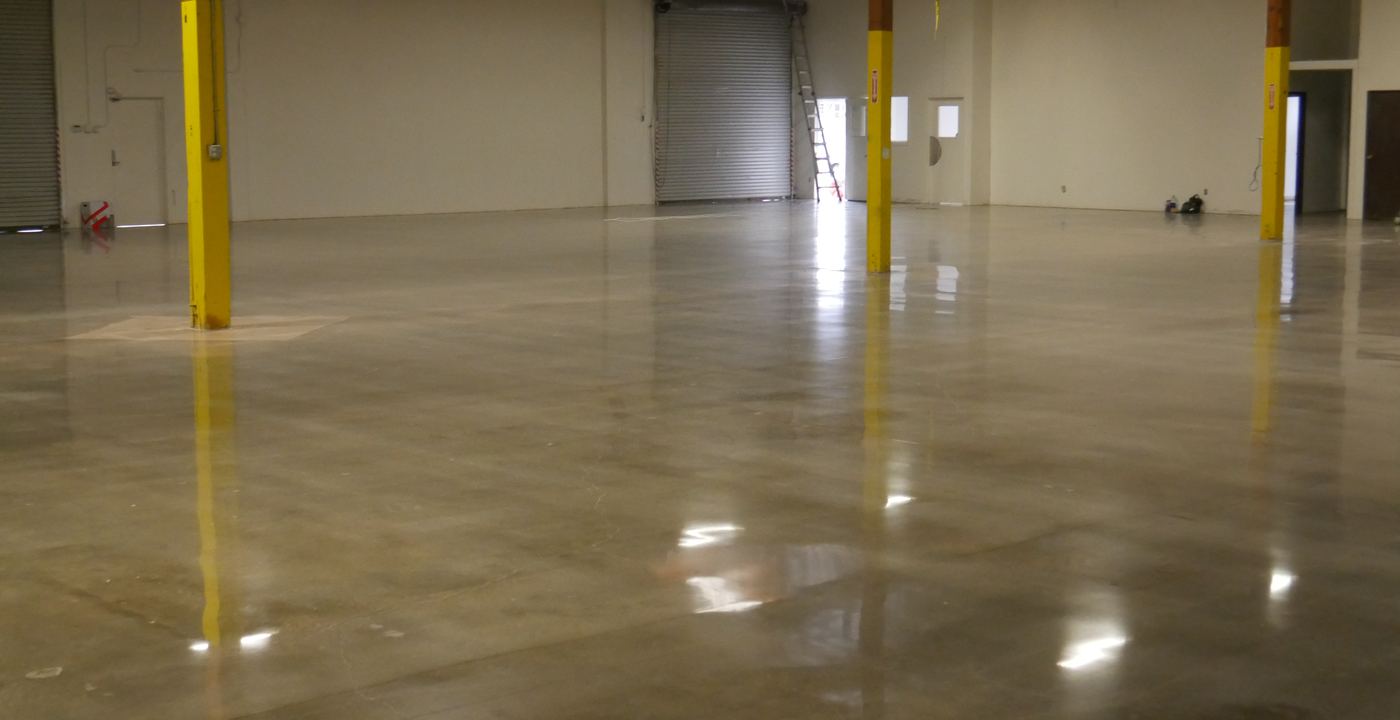
A warehouse and a rowhouse basement can both be polished, but they are different projects.
In commercial and retail space the draw is durability and light. A polished floor stands up to carts, pallet jacks and foot traffic with no coating to wear through, and reflectivity brightens a big room. Open floors grind efficiently and can often be phased around a store or an operating schedule. The concerns are tire marks, saw-cut joints that need filling and keeping the sheen in aisles. See commercial concrete coatings and industrial floor coatings.
Residential basements are smaller, more cut up and more personal. Walls, stairs, columns and drains slow the machine and need hand work along edges. Slabs are older, with patches where plumbing has been opened. The finish is usually quieter, satin with salt-and-pepper exposure, and owners care about warmth and moisture. See residential concrete floors.
A polished floor has no film to trap moisture, which helps on older slabs, but moisture still matters. It can darken the surface, soften dye and make a basement smell damp. Older homes often have no effective barrier between soil and slab, or one that has torn. The two standard tests are ASTM F2170, which reads relative humidity in a probe hole drilled to 40 percent of slab depth, and ASTM F1869, which weighs moisture a calcium chloride dish absorbs over 60 to 72 hours. Neither sets a pass or fail line by itself. The limits come from the product being installed, and F1869 is not used on lightweight concrete. Test first, and let the result shape the plan.
Probes read relative humidity deep in the slab, which is what a basement polish or dye will live with over time.
A sealed dish on the surface weighs the moisture it absorbs; useful, but it only sees the top of the slab and is not used on lightweight concrete.
Pass or fail limits come from the product being installed, not from the test. Illustration, not to scale.
Older slabs around Alexandria, Arlington and DC are often good candidates and sometimes tricky ones. Fairlington's garden apartments went up in 1942 to 1944 and Parkfairfax in Alexandria in the same wartime window, a reminder of how much of the close-in DMV predates modern moisture detailing. Dense, well-cured old concrete can polish beautifully. It may also carry decades of paint, tile glue, patched drain moves and stains from a water heater leak, and each has to be found and handled first.
DC rowhouse basements are frequently heated and finished, and owners compare polished concrete with microcement and overlays. Heating a basement helps dry it, but test the slab and fix drainage or gutters first, and be wary of anyone who calls a floor moisture-proof. If the slab is too rough to polish, a polishable overlay can be an alternative, discussed at estimate.
Radiant heat and polishing work together when planned. Hydronic tubing generally wants about 2 inches of concrete cover for even surface heat, and saw cuts can hit tubing, so joints must be planned around the loops. A cracked slab that is moving may not suit tubing at all.
Freeze-thaw and road salt matter at entries and garages more than basements. Mats at doors help, and a garage usually does better with a flake system than a polish.
Polished concrete needs less than most floors, but it is not maintenance-free. The goal is to keep grit off and spills from sitting.
Dust mop often with microfiber, because grit scratches like sandpaper. Damp mop with a neutral pH cleaner and avoid acidic, citrus or butoxy-ethanol cleaners that dull the surface. Wipe oil, wine and acidic spills quickly.
Waxes and acrylic finishes are unnecessary and build up. Traffic lanes can dull and benefit from a light burnish or a refreshed guard, which is a service visit, not a redo. Use felt pads and entry mats.
We do not put numbers on a web page, because the same square footage lands in very different places depending on the job. These are the factors that move a polished concrete estimate.
Polish quality is easy to claim and hard to see until it is down. These questions separate real polishers from people who rent a grinder.
Questions
Polished concrete is the slab ground and hardened until it shines. Epoxy is a resin coating applied on top. Polishing has no film to peel but shows the slab's flaws. Epoxy hides most flaws and resists chemicals better, but it is a layer that can fail if prep or moisture was wrong.
Most sound slabs can, including older ones. We check hardness, flatness, cracks, patches and any paint, glue or curing compound before recommending it. A soft, oil-soaked or heavily patched slab may suit grind and seal, an overlay or a coating better, and we say so.
Any smooth hard surface can be slippery when wet. ANSI A326.3 sets a wet DCOF of 0.42 as the baseline for level interior floors expected to get wet, but the standard notes the test does not predict slips, and results on polished concrete vary. Choose a lower sheen or a slip-resistant treatment for wet areas and ask for test data.
Existing cracks stay part of the floor. We fill and grind them flush so they read as fine lines. New cracking comes from slab shrinkage and movement, not from polishing. Control joints are usually filled and left visible.
It tends to feel cool, and many DC-area owners add rugs. Radiant heat works well when planned, with enough concrete cover over the tubing and joints laid out around it. Moisture is the bigger concern, so test the slab first.
They describe how deep the floor is ground. Cream removes only the surface paste with almost no stone showing. Salt-and-pepper reveals fine aggregate. Full aggregate exposes the larger stone and needs strong concrete and more cutting.
A typical sequence runs from about 100 grit through 200, 400, 800, 1500 and 3000, with densifier applied after the early cuts. Where the contractor stops sets the sheen. Ask for the planned steps in writing.
It depends on area, exposure level, slab condition and the number of grit steps. Houses and small shops are often a few days, while deeper exposure or large floors take longer. Densifier needs time to react. The written estimate includes a schedule.
Densifier and a guard slow absorption, but concrete is porous. Oil, wine, coffee and acidic cleaners should be wiped quickly. A stain that sets may need that area re-ground.
Moisture is tested first with ASTM F2170 or F1869 methods. With no film to trap vapor, polishing tolerates more than many coatings, but leaks, hydrostatic pressure and heavy efflorescence need drainage and repair first.
Dust mop regularly, damp mop with a neutral pH cleaner, wipe spills fast and use mats at entries. Skip wax and acidic or citrus cleaners. Traffic lanes may need a light burnish occasionally.
Floor area, exposure level, sheen, slab condition, repairs, dye or design, access and moisture findings. We measure, check the slab and send a written estimate at no charge. Request one here.
Tell us about your space. We'll recommend the right system and send a free estimate.